
Quick Summary
LED pot lights use considerably less electricity than incandescent options, and their rated lifespan is much longer, so they need replacing far less often. Actual savings depend on how many fixtures you run and how long they stay on. A led pot light suits kitchens, hallways, bathrooms and open-concept living areas where even ceiling light is needed.
- LED pot lights run cool, so they suit ceilings that trap heat from older halogen downlights.
- Their rated life is typically much longer than older bulbs, so changes are needed far less often.
- Fewer bulb changes on high ceilings means fewer ladder trips and a real safety gain.
- Insulation directly above the ceiling requires IC-rated fixtures, confirmed on the fixture label.
- Have a licensed electrician confirm lumen target, beam angle and IC rating before cutting any holes.
Table of Contents
- How LED Pot Lights Compare With Traditional Lighting
- Energy Savings, Lifespan and Lower Maintenance
- Cost of Pot Light Installation Per Light
- Planning Your Layout: Best LED Pot Light Spacing for Living Rooms
- ESA Permit Requirements and Safe Installation for Your Lighting Upgrade
- Book Your LED Pot Light Installation With AMM Electric
- Frequently Asked Questions
How LED Pot Lights Compare With Traditional Lighting
Last Updated: November 19, 2026
Recessed LED pot lights use considerably less electricity than incandescent options, which is one of the most common reasons homeowners give for upgrading. Your actual savings depend on how many fixtures you run and how long they stay on. At AMM Electric, we start every lighting conversation with that comparison, because the savings only matter if the fixtures suit the room.
Where LED Pot Lights Make the Most Sense
LED pot lights earn their place in kitchens, hallways, bathrooms and open-concept living areas, where you need even, ceiling-mounted light without a fixture hanging into the room. They run cool, so they suit ceilings that trap heat from older halogen downlights. Dimmable LED trims also let you set the mood for dinner without buying a separate lamp.
Where Recessed Lighting May Not Fit
Recessed lighting is not the right answer for every ceiling. Some design writers argue against it entirely, and it is worth weighing that view before you cut any holes. A fixture that sits in a low ceiling, a room with limited joist clearance, or an insulated attic above the ceiling can all complicate an install. Ted’s Energy Tips also notes that LED retrofits bring drawbacks alongside their benefits, so check the specifics of your ceiling before committing. Our advice is to have an electrician look at the space first, rather than assuming pot lights will work everywhere in the house.
Energy Savings, Lifespan and Lower Maintenance
Energy use is only part of the story. LED pot lights are rated in hours rather than years, and their rated life is typically much longer than that of older bulbs. Check the rated life on the specific fixture you are considering. Halogen and incandescent bulbs, by comparison, have much shorter rated lives, so they need replacing far more often.
That difference matters most on high or hard-to-reach ceilings. Every bulb change on a vaulted ceiling or above a staircase is ladder work, and falls from ladders remain one of the most common home-injury mechanisms. Fewer changes means fewer trips up, which is a genuine safety gain as well as a convenience.
What Actually Fails Inside an LED Pot Light
An LED pot light is not a single component. It is a light engine (the LED board), a driver (the power supply that converts line voltage to the low DC voltage the LEDs need), a trim or baffle, and a housing or wafer body. Heat is a common cause of premature failure, and a fixture crammed against insulation or installed without the clearance the manufacturer specifies will run hotter and fail sooner. That is why the installation details in the next sections matter as much as the bulb rating.
Maintenance and Troubleshooting a Single Failed Unit
When one pot light in a series goes dark, the fix depends on the fixture type. On a wafer-style fixture with an integrated driver, the whole unit usually has to be replaced from below, the spring clips release and the wafer drops out of the ceiling cutout.
Watch out: mixing fixtures with different color temperatures or dimming protocols on the same circuit can cause flicker and uneven dimming, so replace a failed unit with a matching model rather than the cheapest compatible one.
At AMM Electric, we install LED pot lights with long-term performance in mind, correct clearances, matched drivers, and fixtures rated for the ceiling they sit in, so the savings on your bill keep coming for years rather than being eaten by early failures.
The article summarises how a failed LED pot light is typically diagnosed and fixed, depending on the fixture type.
| Fixture type | Typical fix | Key note |
|---|---|---|
| Wafer-style with integrated driver | Replace the whole unit from below | Spring clips release the wafer from the ceiling cutout |
| Traditional housing with replaceable trim | Swap the driver or trim kit | Housing and wiring can stay in place |
| Any fixture that will not light | Check the wall switch and dimmer first | A failed dimmer or tripped circuit is a common false alarm |
| Several fixtures on one switch fail together | Suspect the circuit or switch | Not necessarily the lights themselves |
Cost of Pot Light Installation Per Light
Pricing depends on the number of fixtures, whether the ceiling is open or finished, the wiring route, and whether a new circuit is needed. Because every house is different, we do not publish a fixed per-light figure here. For a current quote that reflects your ceiling and layout, request a quote from AMM Electric. You can also see the full range of work we do on our services page, and our guide to electrical work costs in Ontario gives useful context for budgeting.
Planning Your Layout: Best LED Pot Light Spacing for Living Rooms
Spacing is the step most DIY plans get wrong, and it is where a little math saves a lot of regret. The goal is even ambient light with a few fixtures you can dim for task or accent work, not a grid of bright spots with dark gaps between them.
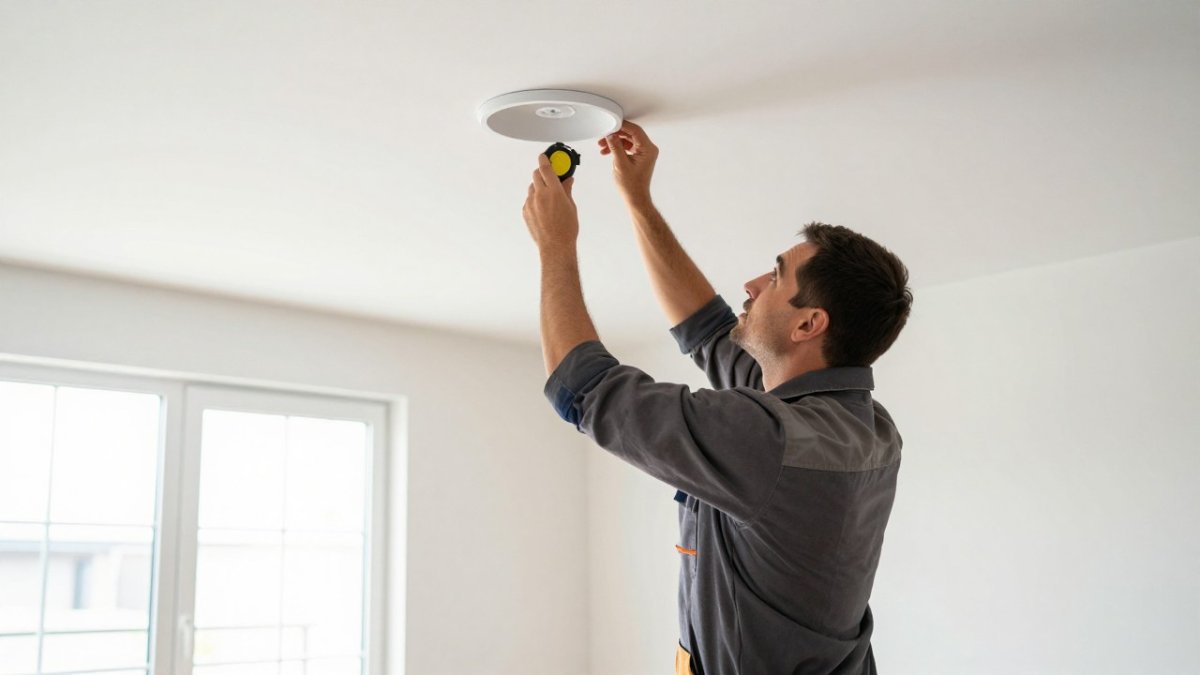
The Lumens-Per-Square-Foot Math
Lighting designers work from lumens per square foot rather than fixture count. Lighting planners often work from lumens per square foot rather than fixture count, and the right target depends on the room’s finishes, its use and the occupants. Ask your electrician to confirm the lumen target for your space before choosing fixtures.
Beam angle changes the answer. A narrow 36-degree beam throws a tighter pool of light and needs closer spacing; a wide 60- to 120-degree beam spreads light further and tolerates wider spacing.
Spacing Rules of Thumb
Fixture spacing should be planned around the ceiling height, furniture and wall positions, and the room’s joist layout, so the light is even across the room.
IC-Rated Fixtures and Ceiling Insulation
This is the detail most guides skip. If there is insulation directly above the ceiling, a top-floor room, a vaulted ceiling, or an attic, the fixture must be rated IC (Insulation Contact). A non-IC fixture cannot safely touch insulation and requires a clearance box, which is both a fire-safety matter and, in many jurisdictions, a building-code requirement. Wafer-style LED fixtures are commonly available in IC-rated versions and are often the practical choice for retrofits because they need very little clearance. Confirm the rating on the fixture label, not just the box.
Smart-Home Integration and Control
LED pot lights are a natural fit for smart control because they dim smoothly and switch instantly. Smart control can be added with smart bulbs in traditional housings or with integrated smart fixtures and dimmers. Discuss the options with your electrician to choose what suits your circuits. Look for fixtures and dimmers that use a standard protocol and are rated for the load, and confirm the dimmer is compatible with the driver, LED drivers vary in how they dim, and an incompatible pairing is the usual cause of flicker or a light that will not go below 20%.
Watch out: over-lighting a room is as common as under-lighting it. Too many high-output fixtures on a dimmer that will not dim low enough leaves you with a room that is either harsh or flickering, plan the lumen target first, then the fixture count.
Ask your electrician to check the lumen target, beam angle, and IC rating against the room’s size and use before any holes are cut. That five-minute conversation is cheaper than patching a ceiling.
ESA Permit Requirements and Safe Installation for Your Lighting Upgrade
New wiring for pot lights must be done by a licensed electrician and meet the applicable electrical safety requirements in Ontario. Before you hire anyone, check that their ESA licence is valid. Installation involves cutting into ceilings, handling live circuits, and making connections that must be IC-rated and properly housed. These are not steps to attempt without training. Working with a licensed contractor helps keep the job code-compliant.
Book Your LED Pot Light Installation With AMM Electric
Upgrading to LED pot lights makes sense when the fixtures suit your ceiling, the layout is planned properly, and the work is done safely. AMM Electric is ECRA/ESA licensed and fully insured, with over 20 years of experience across Mississauga and the Greater Toronto Area. AMM Electric offers free estimates, so you can see what your project involves before you commit. Get a quote from AMM Electric or find an electrician in Mississauga to get started.
Frequently Asked Questions
Are LED pot lights worth the investment?
For most homeowners, yes. LED pot lights use considerably less electricity than incandescent options and last far longer than older bulbs. Their lower running cost and reduced replacement work often offset the higher upfront price over time. The payback depends on how many fixtures you install, how many hours you run them and the rates on your electricity bill. A licensed electrician can estimate the result for your home before you commit.
Do I need an ESA-licensed electrician for pot light installation?
Yes. Installing new recessed fixtures involves cutting into the ceiling, connecting to the house wiring and working with circuits that must meet the Ontario Electrical Safety Code. AMM Electric is an ECRA/ESA licensed and fully insured contractor, and homeowners should ask any electrician for proof of ESA licensing, liability insurance and WSIB coverage before work begins. Unpermitted or poorly connected fixtures can create fire risks.
Can LED pot lights be installed in finished ceilings?
Yes, but the work is more involved than in a new build. The installer must cut openings in existing drywall, check for joists, ducts and wiring, and confirm the fixture is rated for the insulation and clearance in the space. Retrofit LED pot lights are designed for this situation, and an experienced electrician can plan the layout so the finished ceiling is patched cleanly. Some ceilings are better suited to surface-mounted options, so a site visit helps.
Do LED pot lights increase home value?
Improved lighting is often seen as a visible upgrade during a sale, but there is no guaranteed dollar figure for it. Buyers respond to a clean, well-lit, updated home, and modern LED fixtures support that impression. The value added depends on the quality of the work, the local market and how the rest of the house is presented. Keep your permits and invoices, since documented, code-compliant work reassures buyers.
